We’ve all been there. You started your business because you had a vision, a specific passion, or a unique skill you wanted to share with the world. But lately, you aren’t doing much of that core work. Instead, you find yourself drowning in a sea of unread emails, scheduling conflicts, invoice tracking, and social media updates.
When the workload becomes overwhelming, our knee-jerk reaction is usually to push harder. “I just need to pull an all-nighter,” we tell ourselves, or “If I work through the weekend, I’ll finally catch up.” But here is the hard truth: You don’t need more hours in the day; you need support. Constantly trading your sleep, mental health, and personal life for business maintenance isn’t sustainable. It’s a fast track to burnout and a guaranteed way to plateau your business growth.
Let’s look at five unmistakable signs that you’ve outgrown your solo operation, and explore how partnering with a Virtual Assistant (VA) can help you transition from a stressed-out solopreneur to a thriving CEO.
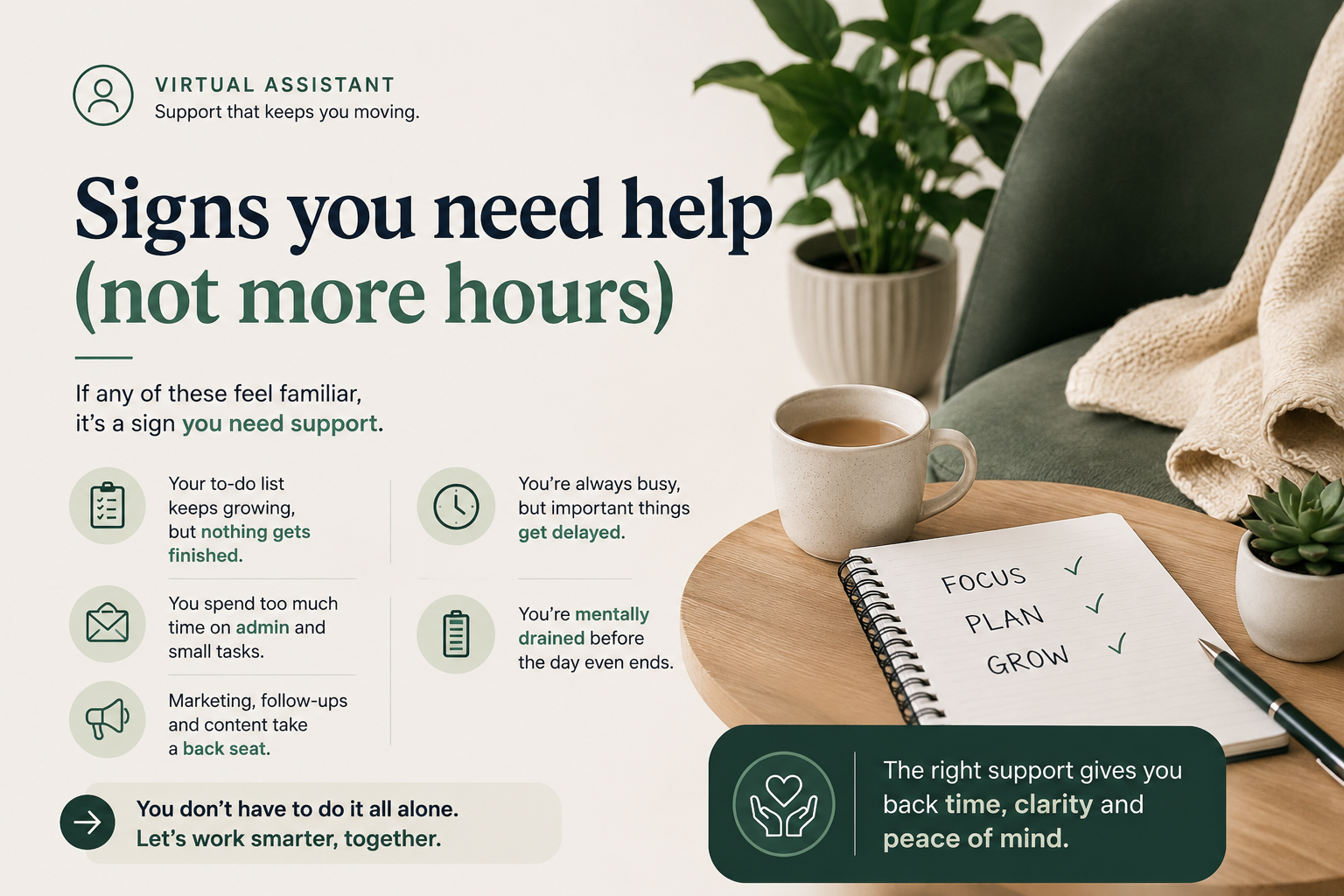
5 Warning Signs That You’ve Hit the Solopreneur Ceiling
If you are unsure whether you are just experiencing a temporary busy patch or a fundamental structural issue in your business, check to see if any of these five signs feel familiar.
1. Your To-Do List Keeps Growing, But Nothing Gets Finished
You start every Monday morning with high hopes and a neatly written task list. By Friday afternoon, that list has doubled in length, but the most critical items are still unchecked. When you are the only one spinning the plates, a single unexpected phone call or a minor tech glitch can derail your entire week. If your project backlog is growing faster than your revenue, your current system is broken.
2. You’re Always Busy, But Important Things Get Delayed
There is a massive difference between being busy and being productive. You might spend eight hours straight staring at your screen, yet none of those hours were spent on high-level strategy, client fulfillment, or product development. When urgent but low-value tasks consistently hijack your schedule, your big-picture goals—like launching that new service or expanding your network—continually get pushed to next month.
3. You Spend Too Much Time on Admin and Small Tasks
As a business owner, your highest income-generating activities (IGAs) usually involve client delivery, sales conversations, and strategic innovation. Yet, a massive chunk of your day is likely consumed by sorting and replying to customer service emails, formatting invoices, chasing down late payments, booking appointments, and doing tedious data entry into your CRM tools. Every hour you spend fixing a formatting issue on a PDF or resetting a client’s password is an hour you didn’t spend making money.
4. Marketing, Follow-Ups, and Content Take a Back Seat
Consistency is the lifeblood of business growth. To keep your pipeline full, you need to be marketing regularly, posting on social media, and following up on hot leads. Unfortunately, when time gets tight, these are usually the very first things to drop off your radar. You stop posting on LinkedIn, your email newsletter goes dark for months, and proposals sit in your drafts folder. This creates a frustrating “feast or famine” cycle where you have no new clients lined up once your current projects wrap up.
5. You’re Mentally Drained Before the Day Even Ends
Do you wake up already feeling tired? Are you experiencing brain fog by 2:00 PM, hitting a wall long before your workday is technically over? Chronic fatigue and decision fatigue are clear indicators that you are carrying a cognitive load that is simply too heavy for one person. When you are mentally depleted, the quality of your work suffers, your patience wears thin, and the passion that originally drove you to start your business disappears.
Working Harder vs. Working Smarter: Why More Hours Won’t Fix It
When business owners realize they are drowning, their default solution is usually to allocate more time. They stay up an hour later, sacrifice their lunch break, or stop taking weekends off.
The problem? Time is a finite resource. You cannot manufacture more of it.
If your business structure requires 60 hours of manual labor per week just to stay afloat at your current revenue level, how will you ever double your business? Under a solo model, doubling your business would mean working 120 hours a week—an obvious impossibility.
The Secret to Scaling: True growth doesn’t come from adding more hours to your personal schedule. It comes from optimizing your existing hours and leveraging the time of others.
By offloading repeatable, administrative, and operational tasks to a Virtual Assistant, you buy back your freedom. You shift your energy from working in your business (keeping the engine running) to working on your business (steering the ship toward growth).
How a Virtual Assistant Transforms Your Business
A Virtual Assistant is more than just a remote contractor; they are a strategic partner in your daily productivity. Here are the core pillars of your business that transform the moment you bring a VA on board:
Focus: Return to Your Zone of Genius
Your “Zone of Genius” is the specific skill set that makes your business profitable and distinct. It’s what your clients pay you for. When a VA takes over customer support, invoicing, and file organization, you get your focus back. You can spend your days doing what you love and what actually drives revenue, rather than being bogged down by background noise.
Plan: Transition from Reactive to Proactive
When you are overwhelmed, you operate entirely in a reactive state—simply putting out whatever fire is burning brightest that day. A VA helps restore order. They can manage your calendar, structure your project timelines, and organize your tasks so you always know exactly what your day looks like. This structure gives you the space to plan long-term business moves with a clear head.
Grow: Build a Sustainable Infrastructure
You cannot scale an disorganized business. A Virtual Assistant helps you build documentation, organize standard operating procedures (SOPs), and streamline client onboarding. With a solid backend infrastructure in place, your business becomes capable of handling double or triple the client volume without breaking a sweat.
What Tasks Can You Delegate to a Virtual Assistant?
If you’ve never worked with a VA before, it can be tough to visualize exactly what to hand over. A good rule of thumb is to delegate anything that is repeatable, administrative, or outside your core expertise. Here is a quick breakdown of common tasks you can hand off immediately:
Inbox Management: Filtering spam, flagging high-priority client emails, answering FAQs, and organizing folders.
Calendar & Scheduling: Setting up meetings, managing time zone differences, sending calendar invites, and protecting your deep-work blocks.
Social Media Support: Scheduling pre-written posts, basic graphic design using templates (like Canva), and engaging with comments.
Customer Service: Onboarding new clients, sending welcome packages, gathering feedback forms, and answering basic troubleshooting queries.
Billing & Invoicing: Creating and sending invoices, tracking receipts, and sending polite follow-ups for overdue payments.
Conclusion: You Don’t Have to Do It All Alone
There is no badge of honor for burning yourself out to keep your business running. Real leadership means recognizing when your business has grown larger than your solo capacity can handle.
If your to-do list is endless, your administrative burden is high, and you are feeling mentally drained before your day even finishes, take it as a sign of success: Your business is growing, and it’s time for your support team to grow with it.
The right support doesn’t just take tasks off your plate it gives you back your time, clarity, and peace of mind. Let’s stop grinding through the overwhelm. Let’s work smarter, together.